Potted history
Fair Trade Electives evolved from an initiative by the Electives Lead and colleagues at Dundee Medical School in 2006. Initially known as Medicine in Malawi Programme they developed using a long-term partnership model that sought to link UK medical students with sub-Saharan partner sites, developed relevant pre-departure training and encouraged students to fundraise for their hosts.
Initially based at Kamuzu Central Hospital in Lilongwe and aided by a grant from the Scottish government, Dundee students could enjoy extended electives, and we were able to support twelve students from Blantyre College of Medicine travel to Dundee for reciprocal elective placements. Subsequently we established two alternative bases, one in Malawi, one Zambia and continued to offer standard and extended electives as well as BMSc project placements. Having rebranded as Responsible Electives (RE) they ‘went public’, inviting applications from other UK medical schools, however, uptake was low and it reverted a Dundee only initiative. Post Covid, placements resumed with the University of Dundee also contributing to each of the sites financially in recognition of the learning they provide for students, and a new site in Rwanda came on board from 23/24.
Ethos
Responsible Electives was established 20 years ago with a set of core values that have largely stood the test of time. Most now underpin Fair Trade Electives.
Ethical
- Transfer of resources and man-power to host sites
- Sustainable programme
- Discourage medical brain drain
- Cultural respect
Educational
- Active student participation
- Risk managed
- Support local health care education
- As part of Global Health curricula
Evaluated
- Educationally quality assured; Impact assessed
Environmental
- Encourage appropriate resource use; Carbon footprint aware
Social
- Promote partnerships and cultural exchange
Student Input
To optimise the experience RE sought committed students as reflected by an interest in an extended placement, a willingness to both fundraise and complete pre-departure training. (Now including personal risk management)
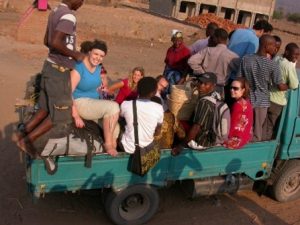
RE sought to support host hospitals by various means, including staff training and exchanges but mainly through charitable funds that could be used however they felt most appropriate. Records are incomplete but at least £49,000 was raised, including an amazing £16,000 by the 2016/17 student cohort. Uses have included supporting staff training, developing local facilities, ad hoc payments for urgent needs such as new ambulance tyres and feeding programmes for malnourished infants (‘Dundee porridge’).
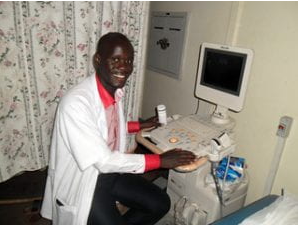
Here is Lombani Mhango, one of the staff at Nkhoma Hospital who Responsible Electives sponsored to train in ultrasonography in Tanzania.
St Francis’ in Zambia became a teaching hospital and RE contributed £12000 to build an extension to their meeting room to facilitate teaching and staff training.
Academic
Responsible Electives has sought to contribute to the growing evidence base upon which more ‘fair trade’ electives can be based. Some but not all of this work has been based on the sites we partner with and often in conjunction with BMSc Global Health student projects. Publications are listed below.
The next era
RE has proved worthwhile and resilient. These twenty years of experience have now been rolled forward into the independent Fair Trade Electives charity (FTE) which has been established to continue this work more broadly in the UK and potentially beyond. Dundee Medical School is proud of the RE programme, what it has offered to many students and of course, our host partners. However, they recognised they were not best placed to grow the programme and opted therefore to move to support the FTE initiative, which took over their host site links in 2025.
Publications
Responsible Electives sought to develop the evidence base upon which more ‘fair trade’ electives can be based. Some but not all of this work has been based on the sites they partnered with and often in conjunction with BMSc Global Health student projects.
- Dowell J, Merrylees N. Medical Student Overseas Electives – Time for Change? Medical Education 2009; 43:121–126 http://onlinelibrary.wiley.com/doi/10.1111/j.1365-2923.2008.03253.x/full
- Hastings A, Dowell J, Eliasz M. Medical student electives and learning outcomes for global health: A commentary on behalf of the UK Medical Schools Elective Council. Med Teach. 2014, 36(4):355-7. doi: 10.3109/0142159X.2013.849330. http://informahealthcare.com/doi/abs/10.3109/0142159X.2013.849330
- Kumwenda B, Dowell J, Ringsel P, Royan D. Western medical students’ experiences on clinical electives in sub-Saharan Africa. Med Ed 2014 Jun;48(6):593-603. doi: 10.1111/medu.12477. http://onlinelibrary.wiley.com/doi/10.1111/medu.12477/full
- Dowell J, Blacklock C, Liao C, Merrylees N. Boost or Burden? Issues posed by short placements in resource poor settings. Br J Gen Pract. 2014, 64(623):272-3. doi: 10.3399/bjgp14X679945. http://bjgp.org/content/64/623/272
- Kumwenda B, Dowell J, Daniels K, Merrylees N. Medical Electives in sub-Saharan Africa – a host perspective. Med Ed 2015, 49 (6): 623-633. doi: 10.1111/medu.12727 http://onlinelibrary.wiley.com/doi/10.1111/medu.12727/full
- Willott C, Khair E, Worthington R, Daniels K, Clarfield AM. Structured medical electives: a concept whose time has come? Global Health. 2019 Dec 3;15(1):84.
- Daniels, K., Thomson, E., Nawagi, F. et al. Value and feasibility of South-South Medical Elective Exchanges in Africa. BMC Med Educ 20, 319 (2020). https://doi.org/10.1186/s12909-020-02224-z